Baby Jesus doll
The Best Christmas Pageant EverThe Baby Jesus doll is first a practical substitute for the infant the Christmas pageant cannot secure, but its importance grows when Imogene Herdman handles it not as a fixed stage image but as a baby needing care. Her treatment of the doll brings the Nativity’s physical vulnerability into view and helps unsettle the congregation’s familiar, polished picture of the story.
Selection as a Substitute
The pageant’s central role is left without a performer after families withdraw the babies they had offered, once they learn that the Herdmans will take part. Narrator's Mother has tried everyone she knows to find another infant; her nearest possibility is a woman who regularly cares for foster babies. Rather than continue the search, she decides the production will use a doll instead. The choice solves the immediate casting problem, but it also places an inanimate stand-in where the pageant’s most consequential figure should be: a newborn who, within the story, has no proper bed.
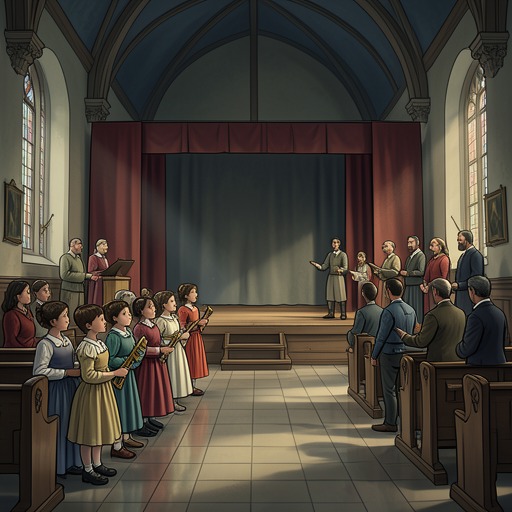
Imogene Herdman accepts the substitution without pretending it is a living child. She points out that a doll cannot bite, a remark that the narrator takes as evidence of the Herdmans’ meanness from the cradle. Yet the doll’s later use complicates that judgment. During rehearsal, Imogene cannot find it and wraps a large memorial flower urn in the blanket instead, dropping the makeshift baby on Ralph Herdman’s foot. Once the doll is found, she tells the Wise Men that she has it and has named it Jesus. Narrator's Mother has to remind her that the pageant’s performers are not supposed to speak; in the established convention, Mary, Joseph, and the Wise Men remain a silent picture while the Angel of the Lord and choir provide the words and songs.
The Doll as a Newborn
At the performance, the doll becomes more than a silent prop in a carefully arranged Nativity scene. When Imogene Herdman and Ralph Herdman enter, Imogene carries it slung over her shoulder rather than cradled in her arms. Before laying it in the manger, she thumps it twice on the back. The ordinary gesture of burping a baby unsettles Alice Wendleken, who wonders whether Jesus could have had colic. The question shifts attention from the doll’s role as a sacred image to the needs of an actual infant: the child in the manger might have been fussy or hungry, like any other baby.
That change in emphasis alters what the pageant makes visible. The congregation has been accustomed to seeing Mary, Joseph, and the Wise Men as a composed tableau, but Imogene’s handling of the doll introduces the practical labor of caring for a newborn into the scene. The narrator recognizes that Jesus did not arrive as an otherworldly figure from a comic book, but was born and lived as a real person. In that recognition, the doll’s lack of life does not prevent it from making bodily vulnerability newly legible; Imogene’s unpolished care gives the familiar image a human scale.
A Prop in a Story Newly Encountered
The Baby Jesus doll enters a pageant whose central story is familiar to the other children but new to the Herdman family. They know Christmas is Jesus’ birthday, yet the shepherds, Wise Men, star, stable, and crowded inn are all news to them. Narrator's Mother therefore reads the biblical account aloud before the pageant can proceed. For the established cast, accustomed to learning only their roles and places, this is a redundant rehearsal; for Imogene Herdman and the others, it supplies the story that gives the doll its meaning.
The Herdmans’ questions turn the Nativity from a sequence of familiar images into a problem of ordinary circumstances. Imogene reacts with disbelief that the inn had no room even for Jesus, while Ralph Herdman asks why Mary did not tell anyone she was expecting. Leroy Herdman wants to know whether the manger was a bed and why there would be one in a barn. Narrator's Mother explains that Mary and Joseph had no bed for the baby and had to use what was available; Imogene answers that the family put Gladys Herdman in a bureau drawer. That personal comparison does not make the doll a realistic infant, but it places its role within a concrete question the pageant’s conventional tableau can leave out: where a newborn can sleep when a family has no proper bed.
The doll consequently connects the story Imogene is learning to the practical, improvised care she already knows how to describe. Its significance does not depend on being lifelike. As an object, it can stand for the sacred infant in the pageant; as something Imogene handles according to the needs she associates with a baby, it also makes the Nativity’s material conditions harder to overlook. The performance’s meaning thus grows out of the meeting between a familiar religious image and a newcomer’s unschooled attention to what a newborn would actually need.
Recognition Beyond the Prop
The doll’s significance extends beyond the performance because the scene it helps embody changes how the narrator understands Christmas afterward. The story had long been familiar as a mystery to be repeated, but the pageant now makes its circumstances harder to abstract away: a newborn arrives to parents with no money, no place to go, no doctor, and nobody they know. The doll gives that vulnerable child a visible place in the tableau, while Imogene Herdman’s practical handling keeps the scene from resolving into a distant, untouchable image.
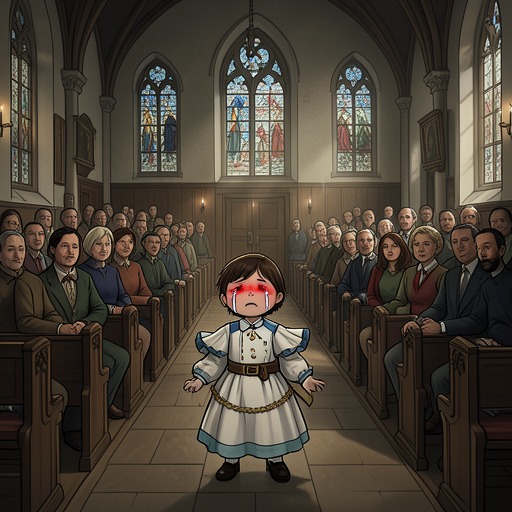
The narrator sees Imogene Herdman afterward in a daze, crying and walking into furniture, as if she has only just grasped the idea of God and the wonder of Christmas. The doll has not changed, but what the pageant can mean has: its small, ordinary stand-in has helped make the birth seem less mysterious and more human.